Showing posts with label common yellowthroat. Show all posts

Monday, September 18, 2023

May-June, 2023

I've already posted about the Eastern Bluebirds who raised their families in our yard this spring and summer, but we had a lot of other cool sightings during that time, too! Here are some highlights from our property during May and June of this year.

May is peak migration time, and it's always fun to get glimpses of the birds that pass through our yard on the way to their summer breeding grounds, near or far. Here's a White-crowned Sparrow on May 7, pausing briefly here during its journey to somewhere in northern Canada:

Migration also meant that we added three new bird species to our yard list in May this year, bringing our total list of bird species seen and/or heard on our property to 116! (Wow!) Bird #114 was a Least Flycatcher who was hunting and calling from a big apple tree in our meadow on May 7 (thanks to Merlin's sound ID feature for helping me to confirm this little bird's identity). Bird #115 was, incredibly, an Eastern Whip-poor-will who called for a few minutes after 9:00 PM on May 11; the bird was singing from somewhere beyond our property, but it was loud enough that I heard it from inside the house. (Eastern Whip-poor-wills are rare around here, and I expect that this was a once-in-a-very-long-while event.) Bird #116 was a Prairie Warbler who moved quickly through our yard, singing a few times, on May 28.

Of course it's also wonderful to come across birds that I see more regularly, especially birds who are only around during the warmer months. This Broad-winged Hawk circled overhead for a bit on May 7; I'm fairly sure that these hawks nest somewhere in the woods bordering our property, but I don't know whether this individual was here to stay for the summer, or whether it was planning to move on:


This male Common Yellowthroat was singing insistently at the edge of the meadow on May 14, perhaps establishing his territory for the season (this is another species that breeds here):


Also on May 14, this male Scarlet Tanager made a nice contrast with newly emerging Shagbark Hickory leaves and flowers:

Just a few days after I took that picture, we had a late hard freeze that destroyed most of this Shagbark Hickory's leaves (and many emerging leaves on other plants, too). This tree and pretty much everything else recovered fine, but it was tough to see so much blackened and bare plant life in the second half of May.

On May 16, I got to admire this Black Swallowtail butterfly up close after it emerged from a chrysalis that overwintered in our unheated mudroom:

Downy Woodpeckers had a nest in a partially-dead tree at the edge of our property this year. I didn't get to see the babies, but I certainly heard them, and the parents made frequent visits. Here's the male at the nest hole on May 27:

On May 30, this Eastern Chipmunk was stuffing its cheeks full of Silver Maple seeds that had fallen from the tree in our front yard:


Those are some big cheeks! And I love this view from behind:

On May 31, a swarm of Honey Bees settled briefly high up in the branches of an oak tree in our front yard:


I'd never seen a Honey Bee swarm in person before! Here's a closer view -- wow, that's a lot of bees:


I didn't take a whole lot of pictures of wildflowers during this time, but here's an especially floriferous Starflower plant along our woods path on June 2; I don't usually see three of these lovely blossoms on a single plant:


And I was pretty well blown away by the Wild Lupine display in our meadow this year. I wonder if these plants were helped along by the extremely dry May we had, or maybe they've just been really successful at increasing their population each year (despite the ever spreading goldenrod). Whatever the reason, there were more lupine flowers in the meadow this year than I've ever seen before, and it was glorious. I'm so glad these plants took off when we scattered their seeds after excavation work in the meadow in 2017! Here's a view of a small portion of the lupine show on May 31:


And a wider view on June 2:


I loved seeing some variations in colors among different plants, like these bicolor white-and-purple flowers on June 4:


These flowers were a big hit with the pollinators, too. Here's a Honey Bee enjoying the lupines on June 5:


This male Brown-headed Cowbird was looking fancy in newly emerging Redbud shoots on June 6 (after the tree's first attempt at new growth was entirely destroyed in the May 18 freeze):

In the woods on June 15, I happened to spot a Small-eyed Sphinx (Paonias myops). This moth was doing a very good dead leaf impression, dangling by its front legs from a Multiflora Rose stem:


Up close, this moth's wings look to me like they're decorated with gold leaf; ah, so pretty, and the shapes of these wings are so interesting:


(Incidentally, Multiflora Rose is one of those nasty invasives that I'm trying to gradually remove from the property; there's quite a lot of it out there, but it hasn't totally taken over any areas yet, and I've been making slow but steady progress each year. My strategy this year was to cut some plants to the ground and place a wide flat rock over each stump, and that actually seemed to work pretty well, as long as the rock was wide enough. Last year, I tried cutting down plants and treating the stumps with triclopyr, which mostly worked, but some of the plants still regrew. We have an abundance of wide flat rocks on the property, so I'll likely keep going with that strategy for now.)

On June 21, I saw one of our Eastern Phoebes hunting in the meadow, using young trees as convenient perches:


Here's another picture of this lovely bird perched on a small hawthorn sapling:


(I wonder how long it will be before this area is no longer quite a meadow, with small trees and shrubs moving in. I don't feel the need to maintain this strictly as a meadow, and I'm very curious to see how this landscape will change over the years.)

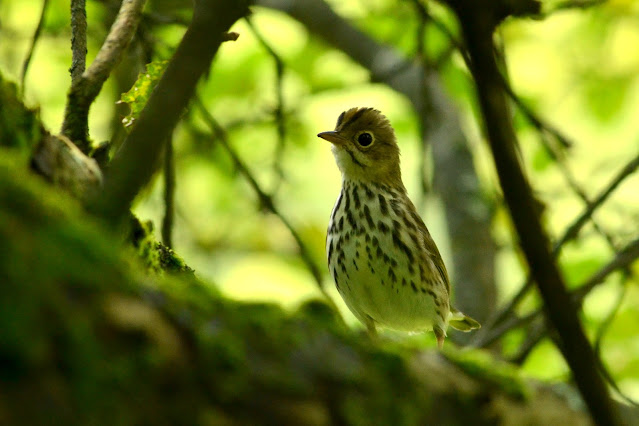
Also on June 21, a couple of Ovenbirds in the woods came near me and made sharp sounds and generally made it clear that I wasn't welcome -- I think they may have had a nest somewhere near the path. Yes, you are bold little birds, and also adorable:

Speaking of adorable, here's a young Tufted Titmouse at the edge of the meadow (also on June 21):


On June 29, I was surprised to see a juvenile Dark-eyed Junco grooming itself right in the middle of a small table on our back deck:


This little bird then sat on the table for several minutes, apparently resting -- it didn't seem to be hurt, and it flew away after a little while, but it was definitely strange to see this young bird lounging on our deck furniture:


Finally, our trail camera in the woods picked up several cool sightings in June, so here's a small selection of clips, featuring: 

  1. Our first sighting of an American Mink on our property. This was a surprise, because I've only seen mink around water before! But this mustelid-type creature was too big to be a weasel and too small to be a Fisher (both of which have appeared on the camera in this spot in the past), and there are wetlands just a little further downhill from here; and it sure looks like a mink.
  2. An Ovenbird doing its chicken-like walk across the log.
  3. A mother White-tailed Deer and her twin fawns.
  4. A Raccoon with two babies (and sounds!).


And that's it for May and June! As I'm writing this, the fall season is arriving (yay, fall!), but the next posts on this blog will feature summer sights. Next up: July!

Saturday, December 31, 2022

The Rest of 2022, Part I: Breeding Birds

Here we are, on the very last day of 2022 (happy almost-new-year!), and it's finally time to catch up with this year's sightings that have been gathering on my computer since March. I took fewer pictures than usual this year, mostly because my beloved camera -- which has seen a ton of use since I got it in 2011 -- simply hasn't been working very well anymore. A new camera is now waiting in the wings, ready to take over in 2023, and I'm super excited to make good use of this new toy. For this year, though, I've made do with my declining SLR camera and the less-than-ideal camera on my phone. Even so! There were a lot of really cool animals and plants on our property this year, and I'm happy to be able to share some highlights from 2022. We had a great deal of activity from our resident summer birds, so I'll start there!

Eastern Phoebes are some of my favorite yearly neighbors, and they were back and raising babies again this year. This was the first year since we moved into this house in 2017, though, that the phoebes didn't build a nest above our front door, and I very much missed having these wonderful birds so close by. (I wonder if the female who usually built the nest at that location is no longer alive....) Instead, the phoebes re-used a nest they built a couple of years ago in the rafters of an old shed on our property, and they raised two broods this year in that nest. Well, almost two broods. The first smooth-white Eastern Phoebe egg appeared in the nest on April 24, and on April 26 there was a speckled Brown-headed Cowbird egg in the nest, too. This is the second year I've seen one of our phoebe nests parasitized by cowbirds, and cowbirds need to live, too. I mean, really, it's pretty amazing that this is their method for raising young; that is, leave it to someone else. In any case, this situation didn't work out well for the phoebes this year. On May 12, the cowbird chick hatched while the phoebes were still in their eggs:


And on May 16, the cowbird chick was huge compared to the one phoebe chick that hatched:


As far as I could tell, the cowbird chick grew up successfully, and no phoebe chicks made it out of that brood. Pretty much immediately after the cowbird fledged, though, the phoebe parents got to work with a new batch of eggs in the same nest. By June 19, they had a nice second brood of phoebe babies:


All of that second brood fledged successfully, so that's a few new Eastern Phoebes in the world, at least!

Only one of our two nest boxes got used this year, first by a family of Tree Swallows -- I'm so happy to see these birds returning to nest in our meadow every year -- and then by a family of House Wrens after the Tree Swallows vacated the box and I cleared out their nest. Here's the lovely collection of Tree Swallow eggs in their feather-lined nest on May 14:

On May 10, I watched a Black-capped Chickadee gathering big beakfuls of moss in the woods and bringing them to a likely nesting spot in a hollowed-out tree right next to the path:


So much moss for such a little bird!


A hole in the chosen tree was fairly well overflowing with moss:


Here's the chickadee perched above the moss-filled hole on May 12 (and it looks like there's some fur in there, too):


I don't know whether the chickadees successfully raised a family in that nesting spot, but it was really cool to see part of the building process, at least.

The Northern Cardinals were super on top of the nesting process, and by May 15 they already had awkward fledglings inching out of their nest in the big fir tree in our back yard:


Wow, baby cardinals look weird! Both of the cardinal parents were on high alert in nearby trees while I was at all in the area. Here's the male cardinal keeping a close watch on me, and looking especially bright against this Shagbark Hickory's newly grown leaves:


On June 19, the cardinals' used nest fell out of its tree, so I got to see this neat construction up close:


Here's the underside of the nest, with wide bark strips from the non-native Beauty Bush (Linnaea amabilis) that grows nearby in the yard:

The same fir tree that hosted the Northern Cardinals in April and May turned out to be quite a popular nesting spot this year, with both Chipping Sparrows and House Finches raising families there later in the summer.

I happened across two Song Sparrow nests on the ground in the meadow this year. I'm not sure whether either of the specific nests I saw were successful, but I saw Song Sparrow fledglings hanging out with their parents in the summer, so something somewhere must have worked out. Here's one bunch of Song Sparrow eggs in their nest on May 25:

A pair of Dark-eyed Juncos had a nest on the narrow strip of sloping ground between our driveway and the road, and somehow they must have managed to protect their nest from the chipmunks and snakes that I often see around here, because on June 4 a couple of baby juncos were hopping around next to our driveway with the anxious parents in close attendance. Here's one of the new babies with its wacky hairdo and tiny stubby tail:


And here's one of the adult juncos foraging a few feet away:

Also near the driveway, the Gray Catbirds built a nest in a tangle of chokecherry shrubs and wild grape vines. The nest was well concealed, so my biggest clue that babies were nearby was the scolding parents. Here's one of the parent catbirds carrying a plump meal to its babies on June 22, and pausing at the top of our arbor (newly added above our front path this year) to yell at me:

This is the best angle I could find to get a glimpse at the catbird babies, and it's not exactly clear, but you can see the bright yellow beak and emerging feathers on one young bird at least; this picture is from June 23:


Those are all the nests I knew about for sure -- and 11 species with confirmed nests on our property is great! Some other birds also made it very clear that our yard was part of their territory, and I hoped that this meant they had families and nests somewhere nearby. The mid-sized apple tree behind our house ended up with a lot of bare branches this year, which made it a great spot to easily see birds. This male Common Yellowthroat sang his somewhat unusual song (with four parts instead of three) from this tree frequently during the summer; here he is on June 23:


I also got used to seeing a male Ruby-throated Hummingbird perched at the very tip of one of this tree's branches pretty much any time I looked at this tree this summer. I don't know for sure that this was always the same individual bird, but this seemed like such consistent behavior that I'm guessing it was a single male. I find it so strange and charming to see such a tiny bird perched so prominently. Here are a few pictures from June 22 and 23:


In this mid-stretch pose, he looks almost ferocious, but adorably so:

Another picture in somewhat better lighting:

I couldn't get enough of this bold little guy:


And here's one more picture of perhaps the same male hummingbird on June 20, because I also love seeing these tiny birds perched on comparatively huge power lines, another common sight in our yard this summer:


On July 17, a Blue-winged Warbler brought its fledglings to our yard while it hunted for caterpillars -- I'm not sure where this family had its nest, but I was glad to see them, since this was my first confirmation that this species breeds somewhere in our neighborhood:

I'm happy that I got to see so much activity from our summer resident birds this year, and I'm also sure that I missed a lot. Why can't I just be outside all the time? In any case, that was 2022's breeding bird highlights! I still have plenty of other sights to share from this year, so keep reading in the next post.

Monday, December 27, 2021

June and July, 2021

When last I shared some sights from around our property -- several months ago, oops! -- it was a green and sunny June. It feels strange to be going back to the height of summer now, when we've just recently passed the Winter solstice, but I can't very well let the second half of the year slip by without highlighting some more of this place's natural goings-on that I love so much. So here are some sights from June and July, 2021!

On June 23, I crossed paths with this male Black-and-White Warbler who snatched up a moth for processing -- I'm pretty sure that's dust from the moth's wings floating around in this picture:

Little colorful creatures in the yard are always fun. Here's a male Ruby-throated Hummingbird showing off iridescent blue/green feathers along his back while visiting hosta blossoms on July 17:


And here's a bright Red Eft (juvenile Red-spotted Newt) making its way across the stone path in front of our house on July 18:


The Eastern Phoebes successfully raised four babies in the nest above our front door, their second brood of the year. On July 16, the babies' eyes were starting to peek open:


And by July 23 the baby phoebes were alert and nearly ready to leave -- I kept my distance for this picture to avoid startling them out of the nest too early; I love seeing the frumpy looks on these little birds' faces when they reach this stage each year:

This lovely Striped Hairstreak (Satyrium liparops) who showed up in our yard on July 8 was a new butterfly for me:

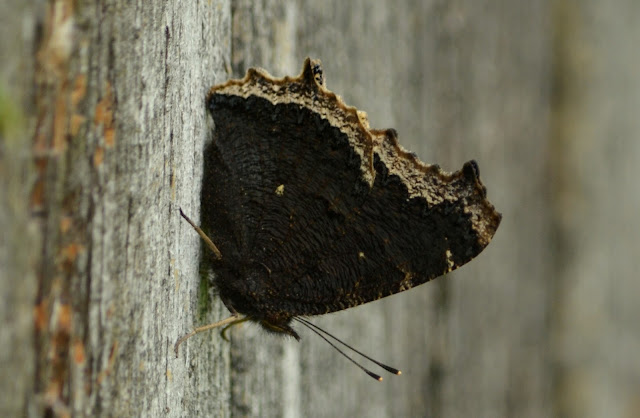
And I love the finely striped pattern on this Mourning Cloak butterfly who was resting on a shed wall on July 16:


On July 21, I found this perfect little cache of Chokecherry berries in the middle of our yard, presumably stored away by a mouse or other little creature for later; the low grass and clover seemed like a strange place to hide food, but oh well:


This small White-spotted Sable (Anania funebris) moth was enjoying some Buttonbush blossoms on July 23:

What a fancy stripey underside this moth has:


Here's another White-spotted Sable on fuzzy Wild Bergamot (Monarda fistulosa) flowers in the meadow on July 28:


Nearby, a Silver-spotted Skipper was also visiting Wild Bergamot blossoms:

And this Eastern Tiger Swallowtail looked extra stunning on Purple Coneflower blossoms:

Meanwhile, this Widow Skimmer hunted from a perch in the sunlit meadow:

One last series of sights from July 28: While walking at the back corner of our meadow, bordering the woods, I must've wandered into the overlapping territories of some very antsy male birds -- perhaps one bird's scolding encouraged the others to come keep a close eye on me as well. In any case, I ended up with some very close looks at three local breeders who usually stay much more hidden and/or distant from me. This male Common Yellowthroat was the first to show himself, popping out of the honeysuckle hedge at the edge of the meadow:

What a fancy guy:

Our resident male Indigo Bunting showed up next -- with his patchy blue-brown-white costume, I assume this is quite a young male, but I'd seen him singing in our meadow at various times this summer, so I suppose he must have successfully established the meadow as part of his territory and had a family hidden somewhere nearby:


And then most surprising of all, an Ovenbird emerged from the woods to perch on an old moss-covered apple branch over the trail and watch me intently:


I don't know for sure whether this was a male or female Ovenbird, but given that the first two birds were territorial males, I assumed that's what was going on here, too:


Either way, this Ovenbird didn't take its eyes off of me while I was in the area, and it stayed quite close:

What a treat to see one of our resident Ovenbirds so close-up, and it was being such a good lookout -- all three of these birds did a great job, really, and I felt lucky to meet them:


I had the trail camera running in the woods throughout June and July (and then I neglected to set it up for the rest of the year), so here are a few video clips from our woods trail when no people were around:

1. A Raccoon pausing to survey the woods at night.

2. A mother White-tailed Deer with her baby, the mother making soft raspy vocalizations (what was she saying?).

3. A young White-tailed Deer (the same one from the previous clip?) getting close to the camera.

4. An Ovenbird picking out a morsel (a caterpillar?) from the forest floor.

Every year continues to be a mixture of increasingly familiar sights and new surprises. There's more to share from 2021, so that'll be the next post!